

Buying a B2B email list should make it easier to reach the right companies and decision-makers. But what happens when the email addresses are valid, yet the contacts have no connection to your product?
You end up paying for data that your sales team cannot use.
If you are wondering where to buy a B2B email list, you have several options: specialized B2B data providers, subscription-based prospecting platforms, custom list-building services, and email list brokers.
The right choice depends on the companies you need, the people you want to contact, the information required for your campaigns, and how much control you need over the final database.
Before purchasing, evaluate seven things: verification, USA coverage, customization, pricing, sample quality, compliance, and provider suitability.
This guide explains how to compare your options, identify unnecessary costs, and select a business email list that matches your actual requirements.
Quick answer: You can buy B2B email lists from specialized data providers such as TargetNXT, use subscription-based business contact databases, or commission a custom list from a data research provider. Before paying, request a representative sample, confirm the targeting filters and verification methods, and understand the final price and usage rights.
Where to Buy B2B Email Lists: Your Main Options
Not every company selling business contacts operates the same way.
Some give you access to a large searchable database. Others build a contact list based on your requirements. Some act as intermediaries, sourcing records from external suppliers.
Understanding these differences helps you avoid paying for a service that does not match how your team works.
| Where to Buy | Best Suited For | What to Consider |
|---|---|---|
| Specialized B2B email list providers | Companies requiring targeted business contacts and custom segmentation | Coverage, verification, sample availability, delivery format |
| Subscription prospecting platforms | Teams researching and exporting contacts regularly | Credit limits, subscription costs, export permissions, database depth |
| Custom list-building services | Specialized industries, technologies, roles, or complex targeting requirements | Research scope, availability, turnaround, validation methods |
| Email list brokers | Buyers sourcing from multiple external data suppliers | Data origin, supplier accountability, freshness, licensing |
Specialized B2B Email List Providers
Specialized providers supply business contact information based on criteria such as industry, company size, job function, seniority, technology usage, and geographic location.
For example, a healthcare technology company might request hospital IT directors and chief information officers at US healthcare organizations with 200–2,000 employees.
Rather than purchasing a broad database and sorting through irrelevant contacts, the buyer can ask for records that satisfy those criteria.
This model is particularly useful when your targeting requirements are already defined and you want an exportable list for an approved sales or marketing workflow.
Subscription-Based B2B Email Databases
Subscription platforms let teams search, filter, and export contacts from a database.
They can be useful for organizations conducting ongoing prospect research across several markets. However, buyers need to examine how credits are consumed, which records can be exported, whether credits expire, and what happens when the subscription ends.
A low introductory price may not represent the actual cost of obtaining the number of usable contacts you need.
Custom Data Research Providers
A custom list-building service becomes valuable when your requirements are too specialized for standard database filters.
You might need contacts at US financial services companies using a particular enterprise software product, operating within specified states, and employing a minimum number of people.
The provider may need to combine company research, contact identification, enrichment, and verification to prepare the requested list.
Before placing the order, confirm which targeting conditions can actually be validated.
Email List Brokers
An email list broker connects buyers with business contact data from one or more sources.
This can provide access to different markets, but you should establish who originally collected the data, who is responsible for updating it, and which company handles incorrect records or replacements.
An intermediary does not automatically guarantee better coverage or data quality.
The buying decision: Choose the purchasing model that fits your market, workflow, and frequency of use. Then evaluate the actual provider against the seven checks below.
7 Things to Check Before You Buy a B2B Email List
These seven checks apply whether you are purchasing a few thousand business contacts, comparing enterprise databases, or commissioning a specialized USA email list.
1. Check When and How the Email List Was Verified
A provider might advertise millions of business contacts, but database size does not tell you how recently those contacts were reviewed.
Business data changes as professionals move between companies, job titles evolve, organizations merge, and email addresses become inactive.
A business email list can contain a correct company name and still have outdated contact information.
Before purchasing, ask:
- When was the requested segment last verified?
- How are business email addresses validated?
- Does the provider check whether contacts still work at their listed companies?
- Are automated checks supported by manual research?
- What happens when delivered records are invalid?
Verification should cover more than the technical existence of an email address.
A provider may check email syntax, domains, mail-server signals, contact-company associations, and professional information. Each method answers a different question, and no single method guarantees delivery.
Consider the following example.
| Record Detail | Database A | Database B |
|---|---|---|
| Contact name | Available | Available |
| Business email | Syntax checked | Validation checks documented |
| Current company | Not recently reviewed | Employment association reviewed |
| Job title | Historical record | Recently checked |
| Verification date | Not disclosed | Available for requested segment |
| Invalid-record policy | Unclear | Written replacement terms |
Database B gives the buyer more information to evaluate. That does not guarantee every record is correct, but it makes the purchasing decision more informed.
What to ask the provider: "How recently were the contacts in my requested segment checked, and what happens if some records are invalid?"
Avoid relying solely on claims such as "100% accurate," "zero bounce," or "guaranteed inbox placement." These promises do not reflect all the variables involved in email delivery.
2. Check USA Coverage and Targeting Accuracy
If you are buying B2B email lists in the USA, the total number of global contacts is not the most useful metric.
What matters is the number of relevant US contacts matching your requirements.
Imagine a provider advertises 50 million business contacts worldwide. You only need procurement directors at hotel management companies in California, Texas, and Florida.
The global database figure tells you very little about how many usable records exist within that segment.
Look for providers that can support relevant combinations of:
- Geography: Country, state, city, and ZIP code where available.
- Industry: Industry classification, sub-industry, NAICS, and SIC codes.
- Company information: Employee count, revenue, business type, and location.
- Professional role: Job title, department, seniority, and purchasing responsibility.
- Technology: Installed business software or technology categories, when available.
For US campaigns, also clarify whether location refers to the company's headquarters, a regional office, a facility, or the individual professional.
A company headquartered in New York may have operations and decision-makers across multiple states. Headquarters-only filters can miss relevant prospects or include contacts working outside your intended territory.
What to ask the provider: "How many unique companies and contacts match my exact US targeting criteria, after exclusions and deduplication?"
Request separate counts for companies and individual contacts. Ten thousand contacts could represent ten thousand different businesses or multiple professionals at a much smaller group of accounts.
If your campaign depends on market-specific targeting, explore TargetNXT's B2B Email List and Business Contact Database for customized geographic and company segmentation options.
3. Check Whether You Can Customize the Email List
Many buyers make the mistake of choosing an available list first and adjusting their campaign around the data afterward.
It should work the other way around.
Your ideal customer profile should determine which contacts belong in the database.
A custom email list allows you to select records based on the characteristics of companies and professionals you actually want to reach.
For example, suppose you sell student information management software to educational institutions.
Your requirement might look like this:
| Selection Criteria | Example Requirement |
|---|---|
| Country | United States |
| Industry | Education |
| Institution type | Private colleges and universities |
| Institution size | 1,000+ enrolled students |
| Relevant departments | IT, administration, operations |
| Seniority | Director, VP, C-level |
| Required contacts | IT directors, CIOs, administrative leaders |
| Additional filters | Specified student information systems, where verifiable |
| Exclusions | Existing customers and institutions outside your supported market |
A broad education email list might include K–12 schools, unrelated academic roles, or institutions outside your preferred market.
A properly scoped custom list reduces the amount of filtering your internal team must do after delivery.
However, customization has limits. Not every provider can validate every technology installation, purchasing role, campus location, or highly specialized requirement.
Ask the provider which filters are available, which require additional research, and which cannot be reliably confirmed.
What to ask the provider: "Can you combine my targeting criteria, apply exclusions, and provide a sample showing the resulting records?"
If you already know your market, you can explore custom B2B email list options from TargetNXT.
Want to inspect relevant records before committing to an order? Request a custom B2B email list sample based on your selected industry, geography, and decision-maker roles.
4. Understand Email List Pricing and Hidden Costs
One of the most common questions buyers ask is: How much does a B2B email list cost?
There is no universal price.
Email list cost varies according to the provider's pricing model, number of contacts, targeting complexity, available data fields, research requirements, and licensing terms.
There are three common purchasing models.
| Pricing Model | How It Generally Works | What to Check |
|---|---|---|
| Per-contact purchase | Pay based on the number of records ordered | Minimum order, field availability, duplicate policy |
| Subscription | Pay periodically for database access or credits | Export limits, overages, cancellation and renewal terms |
| Custom quote | Price based on targeting requirements and research scope | Deliverables, record counts, research fees, replacements |
Consider two hypothetical offers.
Illustrative Offer A
- Broad targeting parameters
- Limited contact data fields
- Verification terms not disclosed
- No replacement policy for bounces
Illustrative Offer B
- Defined ICP & role targeting
- Complete required data fields
- Documented verification framework
- Written invalid-record replacement terms
Offer A is cheaper per record. Offer B may be more appropriate if its records better match the buyer's requirements, but that should be tested through a sample.
Price alone cannot establish which list is the better purchase.
Before paying, ask whether the final quote includes required data fields, formatting, applicable taxes, refreshes, replacement policies, and permitted reuse.
Also verify whether the price covers only access to a platform or includes an exportable dataset you can retain under the agreed licence.
What to ask the provider: "What will I pay for the exact usable dataset, and what additional costs or restrictions apply?"
5. Request Sample Data Before Purchasing
A sample is one of the most practical ways to evaluate a B2B email database before placing an order.
It should demonstrate that the supplier understands your targeting requirements, not merely provide an impressive-looking spreadsheet.
For example, a representative sample may contain the following fields:
| Contact Data | Company Data | Targeting and Verification Data |
|---|---|---|
| Contact name | Company name | Industry |
| Business email | Website | Company size |
| Job title | Headquarters location | Technology usage, if available |
| Department | State and city | Verification status |
| Seniority | Revenue range | Last-reviewed date, if provided |
| Phone, where available | Industry classification | Source or verification methodology details |
The exact fields vary by provider and purchased package.
When reviewing sample data, perform four separate checks.
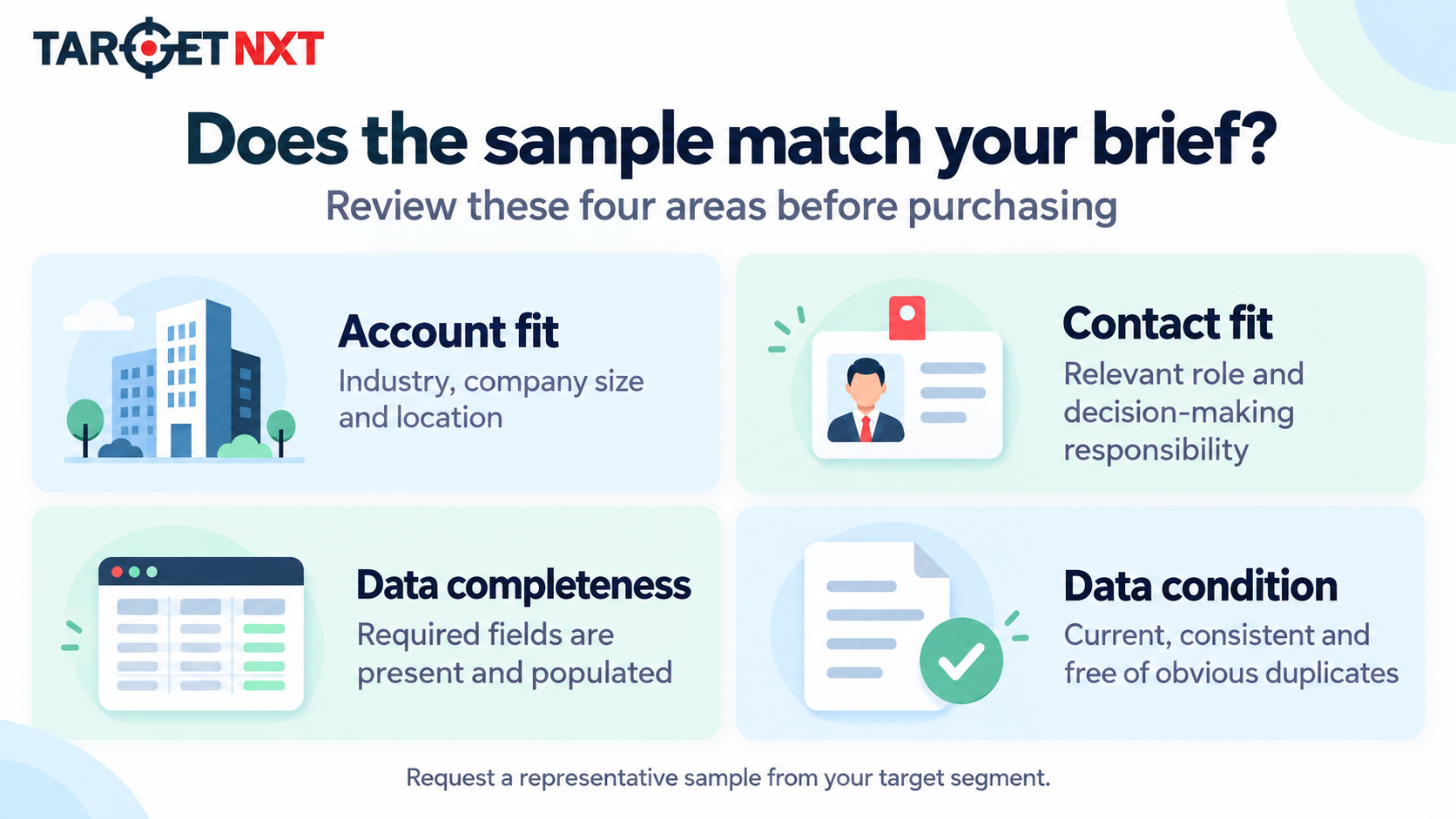
Does the business operate in your intended industry, size range, and geographic market?
Does the listed professional have a relevant role or decision-making responsibility?
Are the fields needed by your team present and populated?
Are records consistently formatted, reasonably current, and free from obvious duplicates or inconsistencies?
Do not judge a sample solely by how many columns it contains. A smaller set of usable fields may be more valuable than dozens of incomplete attributes.
Ask whether the sample was selected from the same segment as the final deliverable. A generic sample from the provider's strongest database category cannot establish quality in a specialized market.
Also establish whether sample records are masked, whether sample recipients can be contacted, and which uses are permitted before purchase.
What to ask the provider: "Can I review a representative sample matching my targeting brief, including the fields I will receive in the final order?"
6. Check Data Sourcing, Compliance, and Usage Rights
Buying business contact information does not remove your responsibility for how that information is collected, stored, and used.
Before selecting a provider, understand its data sourcing practices and whether your planned use is permitted under applicable laws and contractual terms.
For US commercial email, the Federal Trade Commission's CAN-SPAM guidance explains requirements including accurate sender information, non-deceptive subject lines, a valid physical postal address, and an effective opt-out mechanism.
CAN-SPAM applies to business-to-business commercial email as well as consumer-directed marketing.
That does not mean every purchased list is automatically compliant for every marketing activity.
You should establish:
- How the provider obtains and maintains its data.
- Whether the supplier can explain its lawful basis for processing where applicable.
- What licences or contractual restrictions govern the records.
- Whether opt-out and suppression requirements can be respected.
- Whether your email delivery platform allows the intended use of third-party contact data.
- Whether additional privacy requirements apply to the recipients' locations.
For campaigns involving people in other jurisdictions, laws such as GDPR, UK GDPR, or Canadian anti-spam legislation may introduce different requirements. State privacy laws in the US may also be relevant.
A provider's claim of GDPR or CAN-SPAM compliance does not transfer responsibility for your own activities.
What to ask the provider: "Where does the data originate, what rights do I receive, and what compliance responsibilities remain with my company?"
If the provider cannot explain its sourcing approach or commercial usage restrictions, investigate further before purchasing.
7. Compare B2B Email List Providers Against Your Requirements
Searching for the best B2B email list providers can produce long lists of companies, feature comparisons, and database-size claims.
But the provider with the largest database is not necessarily the best match for your campaign.
A general prospecting platform may be suitable for a sales team researching contacts every day. A custom data provider may be more appropriate for an organization requiring a carefully defined set of companies and professionals.
Compare providers using the same criteria and request comparable information wherever possible.
| Evaluation Criterion | Questions to Answer |
|---|---|
| Coverage | Do they have relevant contacts for your industry and country? |
| Verification | Can they explain when and how the records were checked? |
| Customization | Can they combine the filters and exclusions you need? |
| Sample quality | Does the sample match the targeting brief? |
| Pricing | Is the total cost and licensing model clear? |
| Data sourcing | Can they explain provenance and permitted uses? |
| Support | Who handles missing fields, disputes, and replacement requests? |
The goal is not to find a provider that makes the most impressive promises.
It is to find one that can demonstrate a reasonable fit for your requirements before you spend money.
What to ask the provider: "Can you show me what you can actually deliver for my requirements, rather than just describe the size of your database?"
Ready-Made B2B Email Database vs Custom Email List: Which Should You Buy?
Once you understand the seven checks, the next decision is whether to purchase an existing dataset or request a custom-built list.
Both models can be useful. Their suitability depends on your level of targeting precision and how much internal work your team can handle.
| Factor | Ready-Made Email List | Custom Email List |
|---|---|---|
| Targeting | Based on existing segmentation | Based on agreed requirements |
| Availability | May be available for quicker delivery | Depends on filtering and research scope |
| Industry specialization | Varies by available dataset | Can be defined for a specific niche |
| Job-title selection | May include broader role groups | Can target specified roles and seniority |
| Exclusions | May need buyer-side filtering | Can be requested before delivery |
| Pricing | Often based on package or record volume | Often quoted against the requested scope |
| Best suited for | Broad, recurring, or relatively standard markets | Specific campaigns with defined buying criteria |
If you need broad market coverage and have the resources to qualify contacts internally, a ready-made database may be sufficient.
If your requirements involve several overlapping filters, specialized buying roles, or exclusion criteria, a custom list may reduce unnecessary records.
For example, buying a general CFO email list may work for a broad financial services campaign.
However, if you need CFOs at privately held US healthcare organizations with 250–1,000 employees, the ability to customize the list becomes much more important.
The right purchase is not necessarily the one offering the highest number of records. It is the one that gives you relevant contacts in a usable format under acceptable terms.
Where to Buy B2B Email Lists in the USA
Businesses purchasing B2B email lists for US campaigns should evaluate geographic precision as carefully as contact accuracy.
The United States contains markets with different industry concentrations, company sizes, purchasing structures, and regional requirements.
A nationwide database is not automatically suitable for a state-specific campaign.
For example, a business might need:
- Healthcare administrators at hospital networks in California and Texas.
- IT directors at mid-sized financial services companies in New York.
- Procurement professionals at hospitality groups operating across multiple states.
- HR directors at logistics and transportation companies in Georgia and Illinois.
Each requirement produces a different contact segment.
When comparing B2B email list providers for the USA, check whether geography can be combined with relevant company and professional filters.
You should also distinguish between a company's headquarters and the actual location of its operations or decision-makers.
For campaigns involving enterprise accounts, multiple relevant contacts at the same company may be useful. For market-size research, unique company counts may be more important.
Example: Building a Targeted USA Business Email List
Suppose a cybersecurity vendor needs business contacts with the following characteristics:
| Requirement | Selection |
|---|---|
| Country | United States |
| States | Texas, California, New York |
| Industry | Financial services |
| Company size | 100–1,000 employees |
| Job functions | IT, cybersecurity, information security |
| Seniority | Director and above |
| Required fields | Name, business email, job title, company, state, employee size |
| Exclusions | Existing customers, irrelevant subsidiaries |
This targeting brief is more actionable than simply requesting 20,000 US business contacts.
The final available quantity should be established after the provider evaluates the market.
For additional guidance on selecting relevant companies before sourcing contacts, see How to Get a B2B Email List for Your Target Market.
Where to Buy a Custom B2B Email List: Why Consider TargetNXT?
Once your company targeting and contact requirements are defined, you need a provider capable of translating them into a usable dataset.
TargetNXT provides business contact data for organizations looking to reach relevant companies and professionals across industries, geographic markets, job functions, and technology categories.
Its B2B Email List and Business Contact Database offering supports customized targeting, including company attributes, professional roles, and available technographic information.
Rather than beginning with an arbitrary contact quantity, buyers can specify the businesses and decision-makers they need.
What Can You Request from TargetNXT?
Depending on the selected segment and field availability, a custom business email list can include:
| Category | Available Targeting or Data Examples |
|---|---|
| Contact information | Name, business email, job title, department, seniority |
| Company information | Company name, website, industry, employee size, revenue |
| Geographic data | Country, state, city, headquarters location |
| Professional information | Job function, decision-maker role, professional profile |
| Specialized filters | Technologies used, industry classifications, company characteristics |
Not every attribute is guaranteed to be available for every record. Confirm coverage against your actual requirements.
How Does the Purchasing Process Work?
TargetNXT's buying process allows prospective customers to submit their targeting criteria, receive information about available contacts and pricing, and request sample records for review before purchasing.
Define your requirements: Specify the industries, company characteristics, job titles, geographic markets, and additional filters you need.
Explore available data: Review the contact coverage and available attributes for the requested segment.
Request sample records: Examine representative records to determine whether the list meets your requirements.
Review the quote and purchasing terms: Confirm the available quantity, included fields, pricing, delivery terms, and any applicable replacement policy.
Proceed with your selected dataset: Complete the purchase once the deliverables and terms meet your requirements.
See the Contacts Before You Buy the List
Tell TargetNXT which businesses and professionals you need. Request sample records for your market and evaluate the available fields before making a purchase.
- USA or global targeting
- Industry and company filters
- Professional and job-role filters
- Sample data review
Ready to review sample records? Explore TargetNXT's custom segmentation capabilities before ordering.
For more specialized targeting, explore TargetNXT's Custom B2B Data Build Services.
A sample request is not a purchase commitment. It is an opportunity to determine whether the available data matches what your company needs.
B2B Email List Buying Checklist: Review These Before Paying
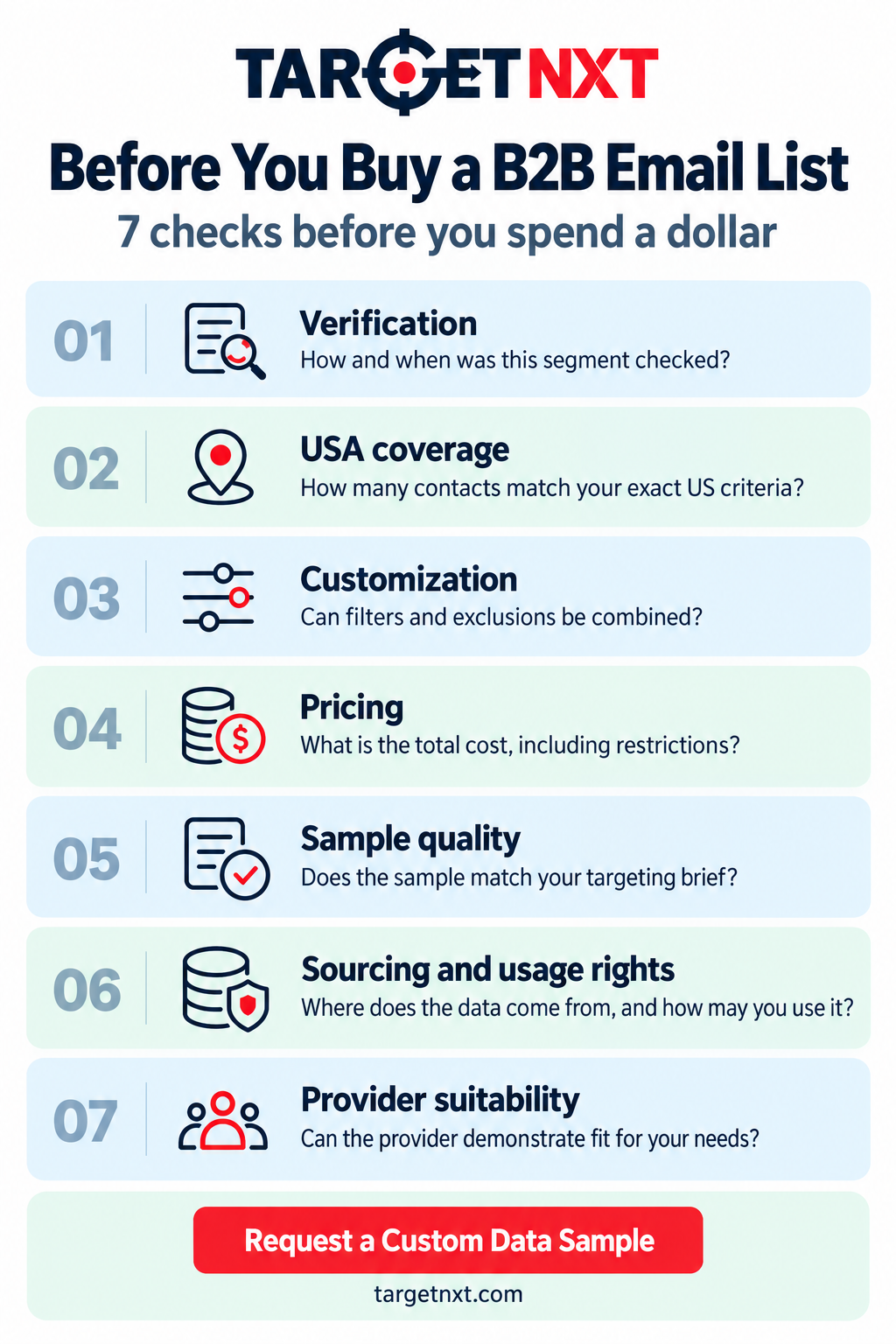
Use this checklist when discussing requirements with a provider or comparing quotations from multiple suppliers.
| Check | What to Ask Before Purchasing |
|---|---|
| 1. Verification | Can the provider explain how and when the requested data was checked? |
| 2. USA coverage | Are relevant company and contact counts available for my target market? |
| 3. Customization | Can the provider apply my industry, role, company size, and exclusion filters? |
| 4. Cost and terms | Do I know the full price, licensing conditions, and replacement policy? |
| 5. Sample quality | Can I inspect representative records matching my exact criteria? |
| 6. Compliance | Can the provider explain data sourcing and usage restrictions? |
| 7. Provider suitability | Has the provider demonstrated that its service fits my workflow? |
One final purchasing rule: If a provider cannot give you enough information to assess its data, do not substitute promises for evidence.
Frequently Asked Questions About Buying B2B Email Lists
1. Where Can I Buy a Verified B2B Email List in the USA?
You can buy B2B email lists from specialized business data providers, custom list-building services, and subscription prospecting platforms. TargetNXT is one option for businesses requiring customized contact lists based on industry, geography, company characteristics, and professional roles. Before choosing a provider, request sample records and review its verification and replacement policies.
2. How Much Does a B2B Email List Cost?
The cost depends on the number of contacts, targeting specificity, available fields, verification requirements, and purchasing model. Providers may charge per record, through subscriptions, or by custom quotation. Compare the total cost of usable contacts rather than looking only at the lowest advertised price.
3. What Should I Look for in B2B Email List Providers?
Prioritize relevant market coverage, documented verification practices, customization, sample availability, transparent pricing, clear usage rights, and support for incorrect records. A large database is useful only if it contains the companies and professionals your business needs.
4. Is It Legal to Buy B2B Email Lists for Marketing in the USA?
Buying business contact data is not automatically unlawful, but the collection and intended use of that data must comply with applicable requirements. The US CAN-SPAM Act regulates commercial email, including B2B messages. Buyers must also consider privacy obligations, suppression requests, contractual rights, and their email platform's policies. Purchasing a list does not establish that every intended use is permissible.
5. How Do I Check Whether a Business Email List Is Accurate?
Request a representative sample and review company relevance, professional roles, contact details, completeness, consistency, and verification information. Ask when records were last checked and how invalid contacts are handled. Email validity and contact relevance should be evaluated separately.
6. Can I Buy a Custom Email List by Industry and Job Title?
Yes. Many B2B data providers offer lists filtered by industry, geography, job title, department, seniority, revenue, and employee size. Some also support technology-based or specialized company filters. Availability varies by segment, so request counts and a sample before finalizing the purchase.
7. What Is the Difference Between a B2B Email Database and a Purchased Email List?
A B2B email database is generally a larger collection of business contact records that can be searched, segmented, or accessed through a platform. A purchased email list is typically a selected dataset obtained for a defined purpose. Subscription databases often provide ongoing access, while custom lists may be delivered as files under agreed licensing terms.
8. Should I Use an Email List Broker or a Direct Data Provider?
A broker can help source records from different suppliers, while a direct data provider may offer more direct communication about its available data, verification practices, and delivery process. Neither model guarantees better quality. Ask who originally sourced the records, who maintains them, and who is accountable for replacements or problems.
Before You Buy, Make Sure the List Fits Your Business
Finding B2B email lists for sale is easy. Finding a list that matches your market, contains relevant decision-makers, and comes with transparent purchasing terms requires more careful evaluation.
Before spending money, establish what you need, examine the sample, and compare providers using consistent criteria.
A smaller, relevant dataset can be more useful than a much larger database filled with contacts outside your target market.
If you already know the companies and professionals you want to reach, TargetNXT can help you explore a custom B2B email list based on your requirements.
Know Who You Want to Reach?
Request a custom B2B email list sample based on your target industries, locations, company sizes, and professional roles. Review the available records before making a purchasing decision.
Request Your Custom Data Sample