

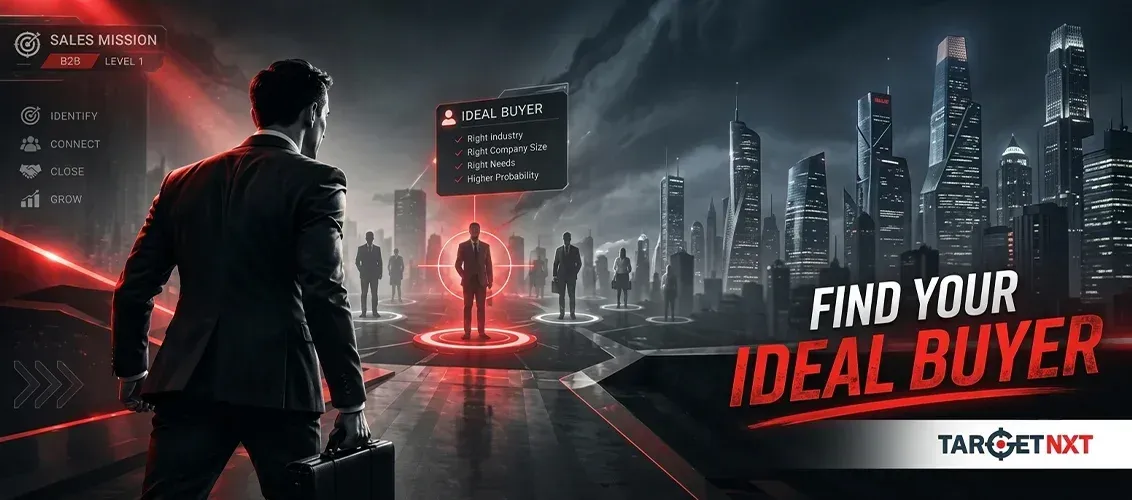
How to identify your ideal buyer in B2B
Start with what your offer does and which organizations can use it. Then identify the people who evaluate, approve, or influence that purchase. Finally, establish whether there is a reason to act now. Buyer Missions lets you practice those decisions before applying them to a real campaign.
A company that fits your product may have no current project. A senior executive may approve spending but rely on someone else to evaluate the solution. A useful growth signal may still leave budget, compatibility, and purchasing access unresolved. Investigating those differences is the challenge.
B2B ideal customer profile examples you can play
An ideal customer profile describes the organization you want to serve. A buyer-role profile identifies the people involved in the purchase. These fictional scenarios combine both, with different routes to a deal.
Healthcare buyers
Practice software might fit a multi-site outpatient group with a scheduling problem. An operations leader can evaluate workflow, while an owner or finance leader approves expenditure. A clinician's interest alone does not establish purchasing control.
Technology buyers
Cybersecurity software requires a compatible device environment and an appropriate IT or security evaluator. Recruitment services need a relevant hiring requirement and access to the people selecting agencies. The same company can fit one offer and not the other.
Manufacturing buyers
ERP migration services may fit a manufacturer planning a supported system transition. Packaging equipment requires a relevant production workflow. IT, plant operations, finance, and procurement can play different roles depending on the offer.
Finance and professional services
A compliance platform needs a supported regulatory workflow, an evaluator, and an approval route. Document software requires a matching document process. A general growth announcement is not enough to establish either opportunity.
Retail and hospitality
A payment system needs compatible operations and access to the merchant's buying process. Workforce software needs a relevant scheduling problem. A franchise location may use the product while head office controls its purchase.
Education buyers
A learning platform needs a relevant teaching workflow and an academic evaluator. Campus IT software needs technical fit and an IT reviewer. Procurement requirements can determine how either vendor becomes eligible for consideration.
Find decision makers, then verify the buying situation
In the game, a purchase can move through an evaluator, an internal sponsor, a budget owner, a service partner, or formal procurement. Choose your first contact according to the task that needs doing. The CEO is not automatically the right starting point, and the person who uses a product may not choose the supplier.
The clues support a decision; they do not make it certain. For a real campaign, confirm the relevance and freshness of company information, technology details, role responsibilities, and any buying signals. Use your own customer evidence and discovery conversations to refine the ideal customer profile.
Turn your buyer profile into a relevant contact list
Specify the industry, geography, company characteristics, technology requirements, and professional roles that matter to your offer. Include disqualifiers and separate confirmed requirements from questions still needing research. This creates a more useful brief than a request for every available contact in a broad category.
Request sample records to inspect fit and field coverage before selecting a larger dataset. TargetNXT's custom B2B email lists and technology users lists provide the relevant starting points for discussing your criteria.
What are you selling, and who should hear about it?
Tell TargetNXT your offer, target market, geography, and required buyer roles. Request a matching sample and assess the records against your criteria.
Request a matching sample →How the deal race works
Buyer Missions is a turn-based B2B sales game. Six fictional accounts contain different product-fit, timing, funding, and purchasing situations. Each paid move consumes one game day and the displayed campaign cash. Browsing is free.
The rival advances after your move. Passing a day costs no cash and keeps the race moving if your budget is exhausted. Accounts signed by the rival close to you, but you can pivot to another eligible company while days remain. Buyer changes on days three and six can add requirements. Tailored demonstrations and pilots can pause rival progress while the buyer evaluates evidence.
A win requires a compatible, active account, evaluation access, complete proof, funding approval, a submitted proposal, resolved buyer requirements, and credibility of at least 20. Standard mode allows 12 days; Expert allows 10 days with less cash and a faster rival. Win one contract before the deadline. No actual sales probability is modeled.
The fictional company's requirements remain consistent within a race. Replay changes names, account positions, rival focus, progress, and events. Game decisions stay in page memory. There are no real cash prizes.
Is this a sales training tool or a real buyer assessment?
Buyer Missions is a free, fictional B2B sales game for practicing account qualification, buyer identification, and outreach decisions. It is not an assessment of your actual business or real customers. Your mission brief is a scenario example that you can adapt to your offer and validate with your own evidence.